
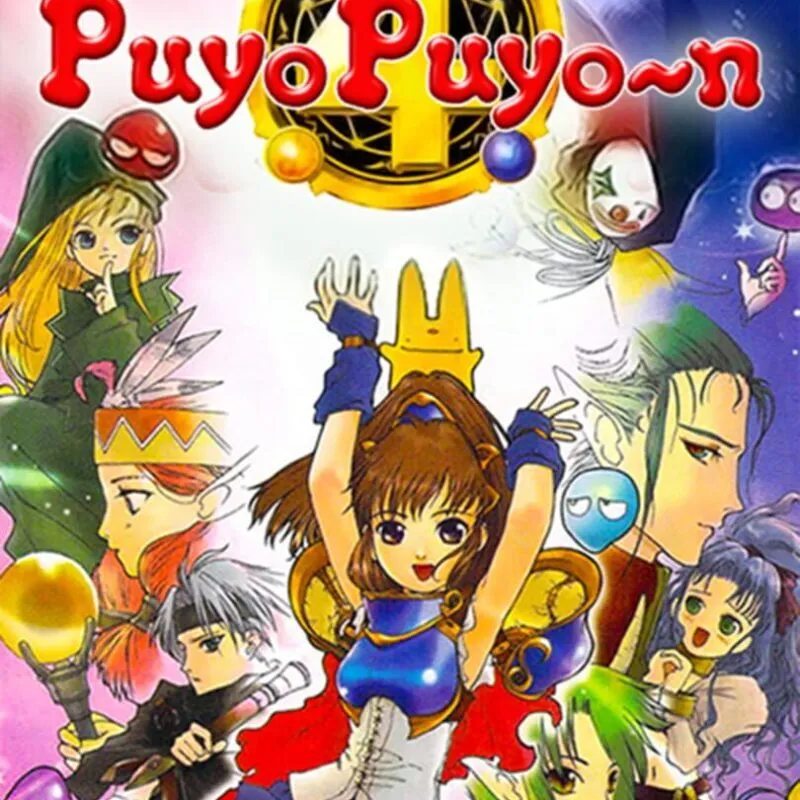
Puyo Puyo~n
This game was released only in Japan. It is the fourth game in the Puyo Puyo series and the last set during the Madou-era in the main series.
Continuing the trend of naming the games after puns, the name comes from a pun on „yon“, the Japanese word for the number 4, but this time this is the only reference to the pun.
The gameplay in is similar to that of Puyo Puyo 2, but adds super attacks. Clearing chains now builds up a „charge meter“ which allows players to use them. The only other addition was a new game mode which could be played with a number of different field sizes, smaller or bigger than the standard 6×12, however, it removes several game modes that were present in Puyo Puyo Sun, i.e. the tournament, task and chain training modes. The art is also vastly different to the previous game in the series and, of course, the Fever series; this style was only otherwise used for Minna de Puyo Puyo.
Storyline
With the advent of the Puyo Puyo Circus, Arle and Carbuncle have come to visit and take part in festivities. Arle makes her way to one of the tents to watch a show, led by Satan as the ringmaster. As part of one of the acts, Satan requests a volunteer to come down to the stage. With Carbuncle as said volunteer, he performed a disappearing act, making him vanish before the crowd. After Arle leaves the tent after the show has concluded, she realizes Carbuncle is nowhere to be found. Thus, Arle begins to explore the circus grounds in search of her friend.
Puyo Puyo~n features a Beginner and Normal course. The Beginner course features the first three stages and does not play cutscenes. Arle cannot use her personal Super attack in story mode, but can call upon the powers of Draco Centauros, Serilly, Witch, and Chico as the player advances. Unlike previous Puyo Puyo story modes, the gameplay rules drastically change between stages.
Due to the length of the Story Mode compared to other Puyo Puyo games, the game saves after every stage. This allows the player to quit and then start back on their current stage without losing progress.
Gameplay Video
Release Dates
Involved Companies
Developer
Publisher
Die gezeigten Daten auf dieser Webseite stammen teilweise aus folgenden Quellen: IGDB.com